

Hospital Bed Comfort and the Patient Experience
It’s a safe assumption that very few patients want to be hospitalized for any length of time. Uncertainty, anxiety, and discomfort over outcomes and treatments are common, along with the disruption to everyday life that hospitalization imposes upon patients and their families.
Patients who are ill and vulnerable need to feel safe and secure in their environments to be able to focus on healing. The rooms they occupy during their hospital stays can significantly impact their recovery process.
When patients positively perceive their hospital room, it enhances overall quality of care, creating a “halo effect” that extends beyond physical comfort and influences how patients judge healthcare organizations and the quality of care they receive.¹
In a study conducted by Ohio State University among patients and family members with hospital stays of three days or longer, accessibility, comfort, control, and security were among the most significant factors impacting their impressions of the quality of care.²
The Centers for Medicare and Medicaid have made the patient experience central to the calculation of value-based incentive payments in the Hospital Value-Based Purchasing program. Under CMS’ Hospital Consumer Assessment of Healthcare Providers and Systems (HCAHPS) quality measure, the hospital environment and a patient’s ability to rest are defined as central dimensions of the inpatient experience.³
HCAHPS makes comfort and rest key performance indicators of how patients perceive hospital care that can directly impact a healthcare system’s bottom line. The right hospital bed can make a world of difference to how patients perceive the quality of care, to the benefit of patients and providers alike.
Considerations for Comfort, Control, and Dignity
Hospital beds are a central component of patient rooms. But when it comes to making patients feel safe and comfortable, one size does not fit all.
A wealth of peer-reviewed studies have conclusively shown that bed width and height can significantly impact patient and caregiver safety. Beds that are too narrow make turning around much harder, particularly for patients with a BMI greater than 35 kg/m2.⁴ Handrail height and grippability can help or hinder patient mobility while in bed, exiting, or entering.⁵
Beds are a major factor in patient falls⁶, making side rails particularly vital to maintaining patient safety, comfort, and control. An estimated 51% of falls occur when patients get in or out of bed; 95% of resultant falls cause minor injuries.⁶
But side rails do more than just help patients move around and get in and out of bed; they also help prevent patients from slipping down, which can have serious consequences for patients on ventilators. Patients who slide down are at risk of ventilator-acquired pneumonia. Repositioning them to help prevent places caregivers at greater risk of musculoskeletal injuries.⁵
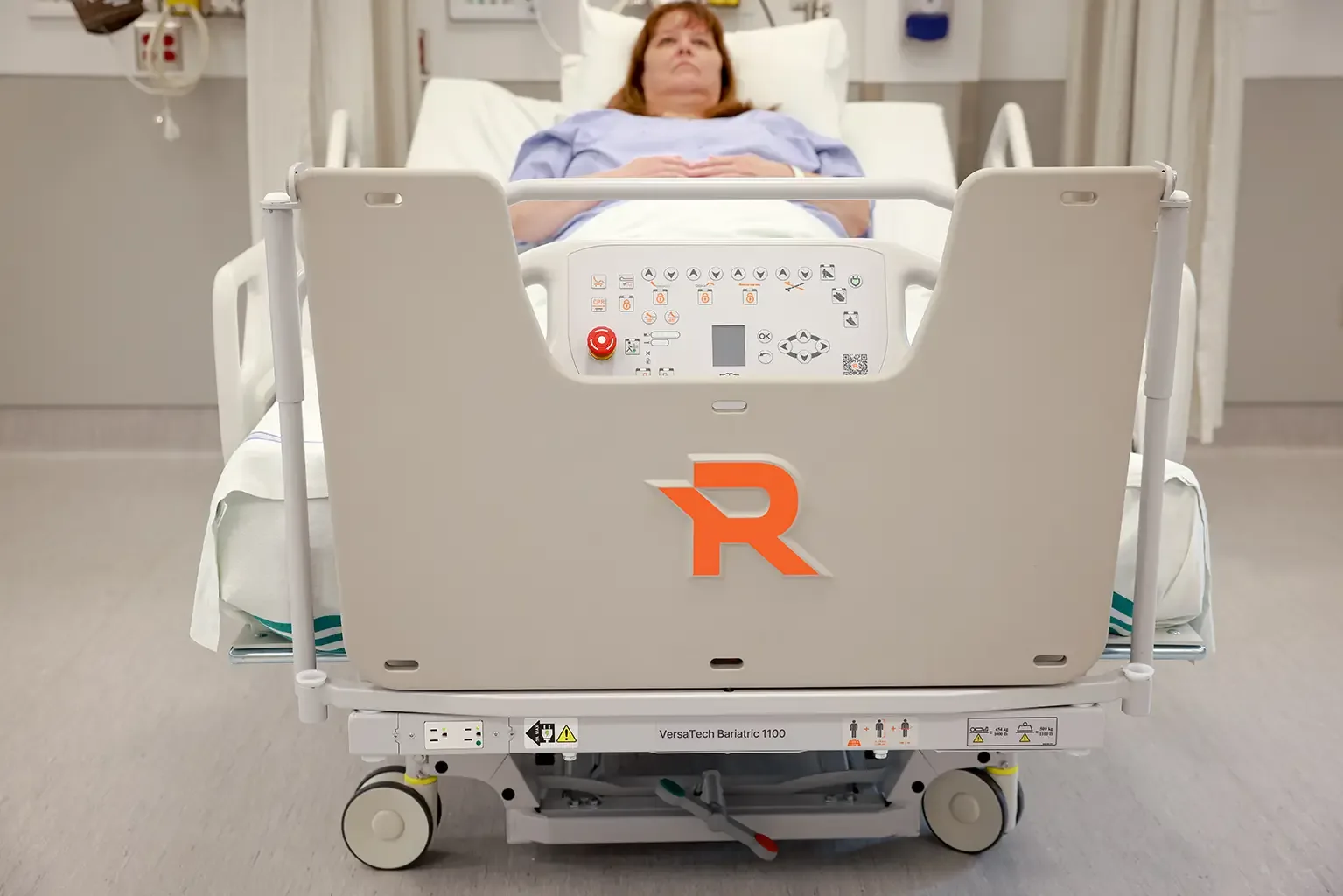
Rotec VersaTech beds offer a safe, dignified alternative to universal bed sizes, featuring bariatric and Med-Surg models that can comfortably accommodate patients of all sizes. Capable of supporting up to 1,100 lb, Rotec’s bariatric bed features the lowest bed clearance; at just 8”, the patented, industry-leading ultra-low profile helps provide maximum protection against patient falls, while safeguarding against caregiver strain.
Unique handrails ensure optimal stability and support, and can be easily adjusted to accommodate individual patient needs. Rotec’s optional VersaDrive, the most intuitive motorized drive assist system available on the market, adds an additional layer of caregiver safety, empowering single-nurse operation while allowing caregivers to maintain eye contact with patients during transport to enhance their overall comfort and emotional well-being.
Illuminated bed components such as nurse-call buttons give patients the confidence that their requests for help are going to be heard, while making it easier to see in lower-light conditions.⁵ All Rotec VersaTech beds are equipped with uniquely designed side rails with integrated patient control, auto-contour, underbed light, and nurse call. Integrated scales with three-zone bed exit notification, and warning signals with visual and audible indicators help further safeguard patients from falls while empowering rapid nurse response whenever needed.
Rotec’s durable steel frames also help ensure that patients can be accommodated with lasting comfort and optimal patient safety. Frames are easily extendable in width up to 48” at the touch of a button. Bariatric and Med-Surg models are easily extendable in length without tools, from 80" to 84" to 88", keeping tall patients easily contained and comfortable during their hospital stays.
Beds That Always Put Patient Needs First
Investing in beds that comfortably accommodate patients of all sizes has a downstream impact on patient recovery and caregiver safety.⁵ And with over one third of the U.S. population with BMIs greater than 30 kg/m4, the need to abandon a “one size fits all” approach to purchasing hospital beds couldn’t be more urgent.⁴
Designed with multiple thoughtful features, Rotec VersaTech beds offer the optimal combination of stability, durability, and patient safety, backed by over 40 years of leadership, warranties that are among the best in the industry, and incredible after-sales service.
Connect with us to learn more about how Rotec can help improve the patient and caregiver experience at your facility.
Sources
- Atsavapranee, Ella, Paul A. Heidenreich, Mystique Smith-Bentley, Alpa Vyas, and Lisa Shieh. “‘Halo Effect’: Room Impacts Patient Perception of Overall Hospital Experience.” BMJ Open Quality 14, no. 2 (2025): e003096. https://doi.org/10.1136/bmjoq-2024-003096.
- Ohio State University Wexner Medical Center. “Study Shows What Patients Need to Feel Comfortable During Hospital Stay.” May 12, 2017. https://wexnermedical.osu.edu/mediaroom/pressreleaselisting/patient-room-comfort.
- Centers for Medicare & Medicaid Services. “HCAHPS: Patients’ Perspectives of Care Survey.” Last modified November 24, 2025. https://www.cms.gov/medicare/quality/initiatives/hospital-quality-initiative/hcahps-patients-perspectives-care-survey.
- Wiggermann, Neal, Kathryn Smith, and Dee Anna Kumpar. “What Bed Size Does a Patient Need? The Relationship Between Body Mass Index and Space Required to Turn in Bed.” Nursing Research 66, no. 6 (November–December 2017): 483–89. https://doi.org/10.1097/NNR.0000000000000242.
- Wiggermann, Neal, Kelli Rempel, Robert Mark Zerhusen, Travis Pelo, and Nick Mann. “Human-Centered Design Process for a Hospital Bed: Promoting Patient Safety and Ease of Use.” Ergonomics in Design: The Quarterly of Human Factors Applications 27, no. 2 (2019): 4–12. https://doi.org/10.1177/1064804618805570.
- Morse, Janice M., Pierre Gervais, Charlotte Pooler, Andrew Merryweather, Alexa K. Doig, and Donald Bloswick. “The Safety of Hospital Beds: Ingress, Egress, and In-Bed Mobility.” Global Qualitative Nursing Research 2 (2015): 1–20. https://doi.org/10.1177/2333393615575321.